Pistol disciplines
Small-bore pistol
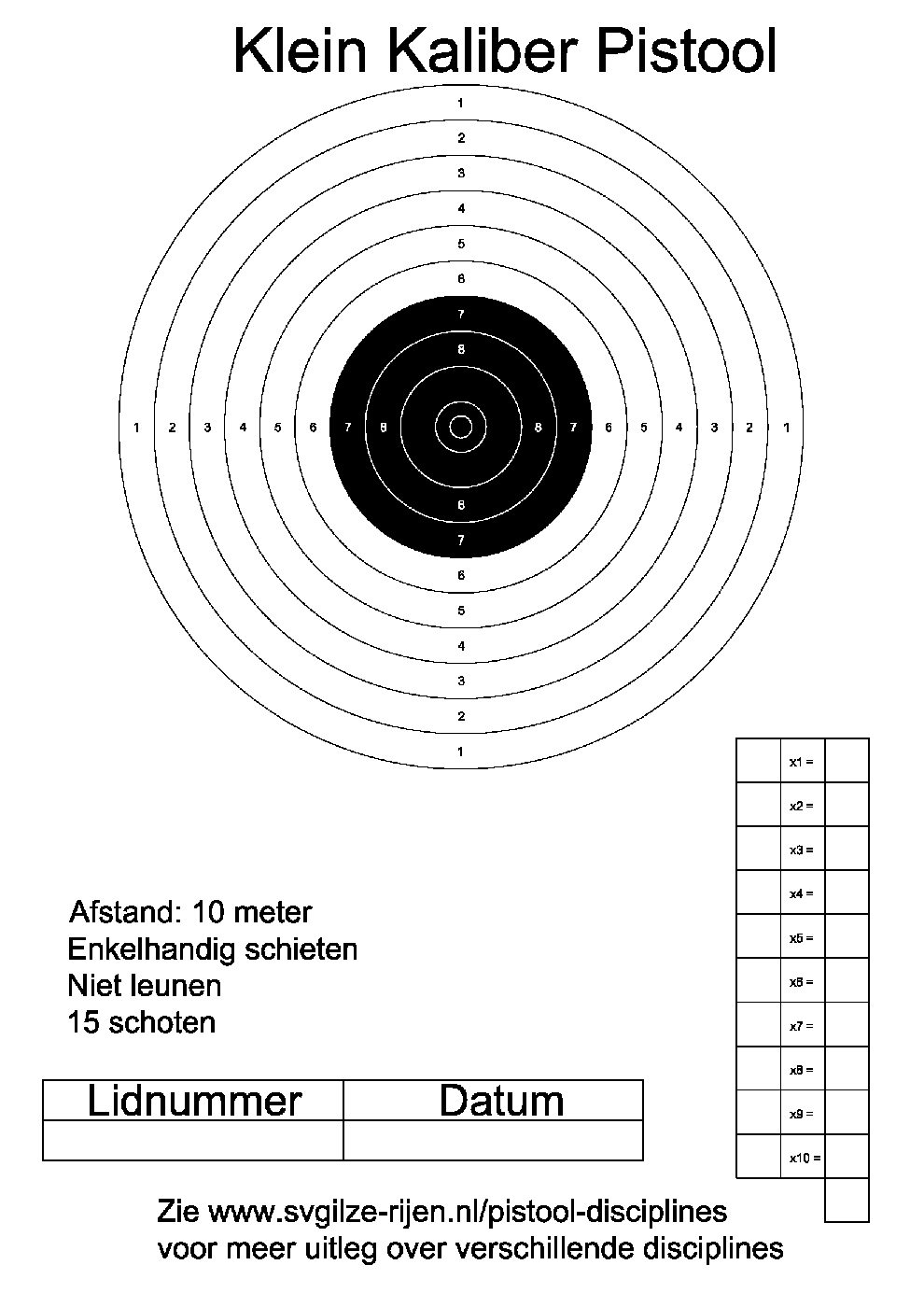
The small-bore pistol match is shot on the international air-pistol target, whose “10” ring is 11.5 mm in diameter and whose “1” ring is 155.5 mm in diameter.
At SV Gilze-Rijen we shoot 15 shots per match card. Sighting shots are unlimited and are fired on a separate card.
The distance is 10 metres. You shoot one-handed and you stand freely, meaning you do not lean against the walls of the firing point or against the bench.
The small-bore pistol discipline is shot with a pistol or revolver in calibre .22 (5.6 mm).
Meesterkaart light and heavy
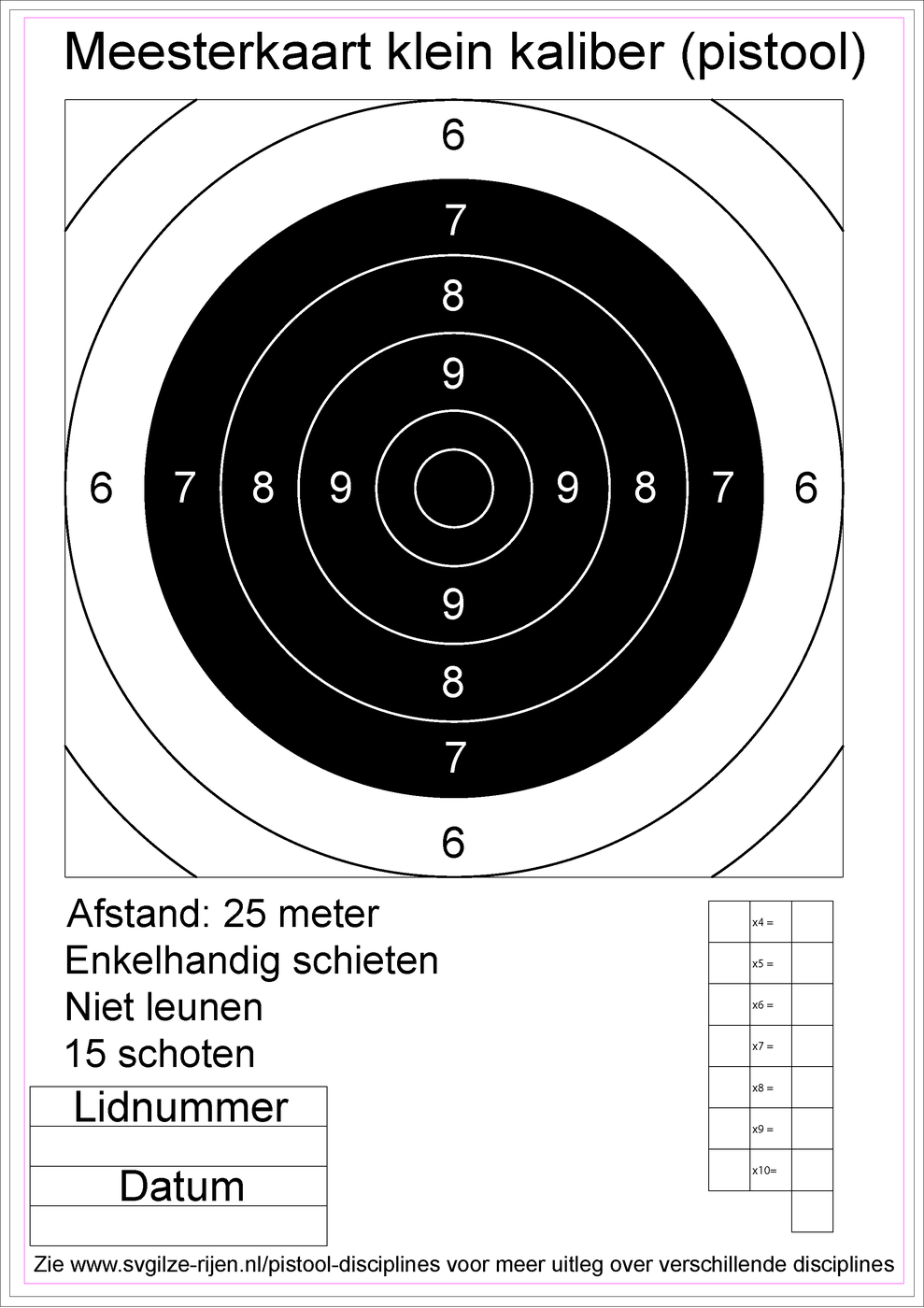
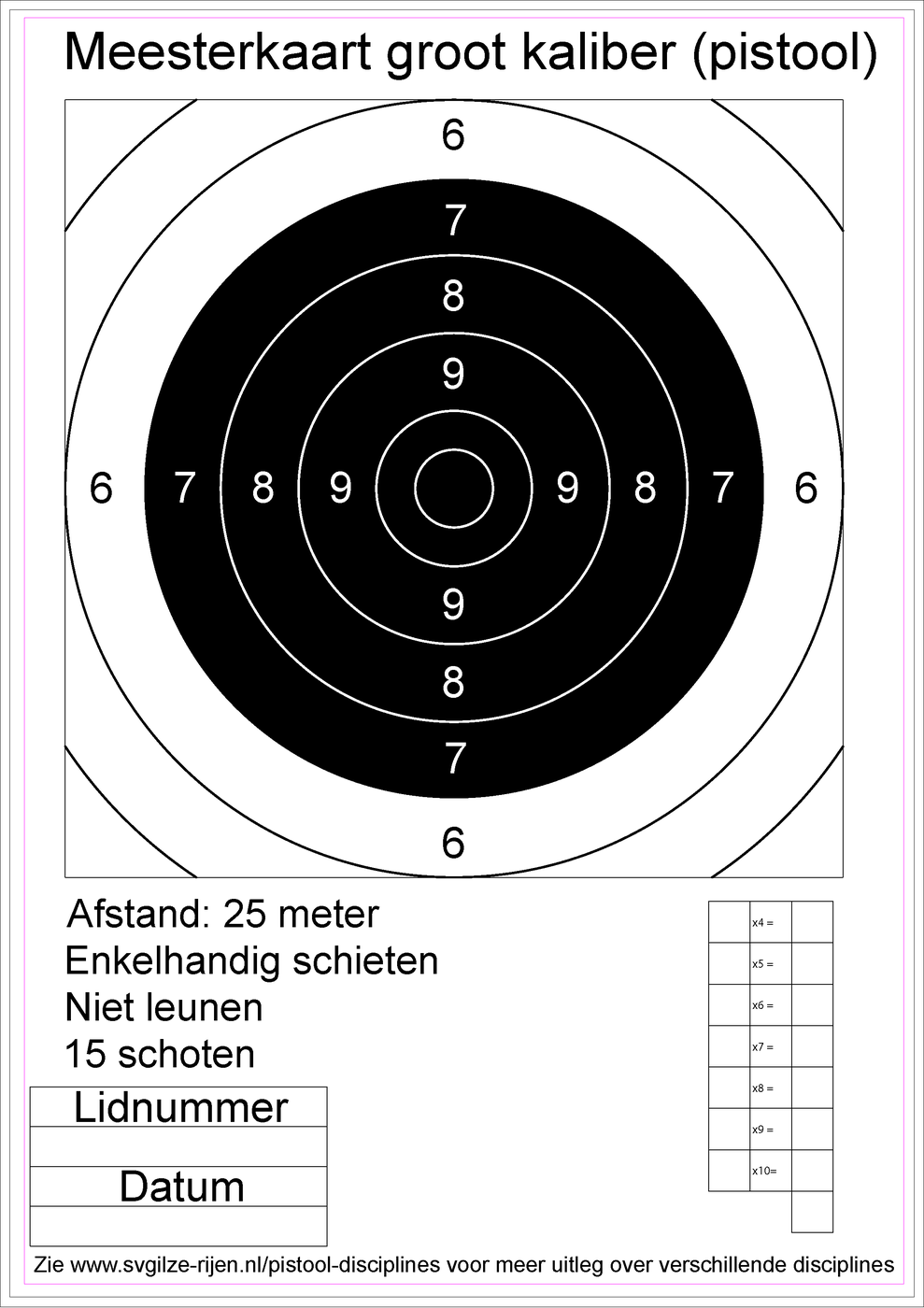
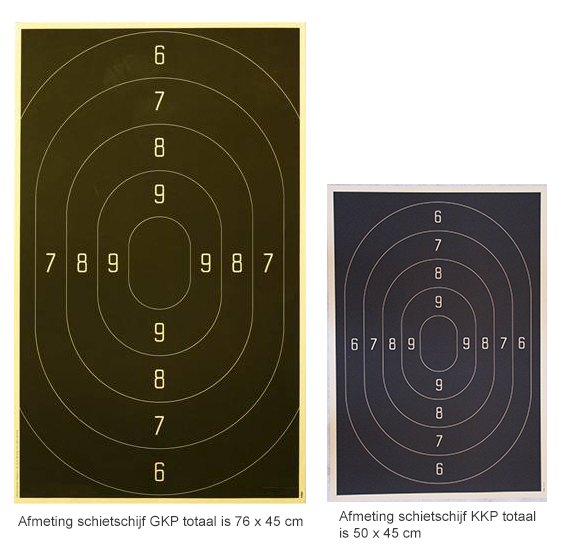
This discipline is shot on the international 25/50-metre pistol target. At SV Gilze-Rijen we shoot 15 shots per match card. Sighting shots are unlimited and are fired on a separate card.
The distance is 25 metres. You shoot one-handed and you stand freely, meaning you do not lean against the walls of the firing point or against the bench.
Meesterkaart light is shot with a pistol or revolver in calibre 5.6 mm (.22).
Meesterkaart heavy is shot with a pistol or revolver in calibre 7.62 to 9.65 mm (.30 to .38).
Military pistol
Small-bore and large-bore, only on the last Monday of the month.
This discipline is shot with:
- small-bore match — calibre .22
- large-bore match — calibre 7.62 to 11.66 mm (.30 – .459)
Stage description:
- one string of six shots, on one target, standing, at 25 metres in 3 minutes
- one string of six shots, on one target, standing, at 20 metres in 15 seconds
- one string of six shots, on two targets (3 shots per target), kneeling, at 20 metres in 12 seconds
- one string of six shots, on three targets (2 shots per target), standing, at 15 metres in 9 seconds
There is no sighting series, and targets are not scored or patched between stages. The matching targets are 3201/60 and 3201.
Strings
- From the 25-metre line you fire six shots on one target only, in 3 minutes. The position is standing, one-handed. When scoring, there may be no more than six holes in the target. If there are more than six, the highest-value shots are discarded.
- From the 20-metre line you again fire six shots on one target. You have 15 seconds. The position is standing, one-handed. Again there may be no more than six holes in the target.
- You stay on the 20-metre line. You again fire six shots, but now on two targets, three per target. You have 12 seconds. The position is kneeling, one-handed. The free hand may not be used for support. There may be no more than six holes in the two targets, three per target. If one target has more than three holes, the highest-value shots are discarded.
- You then walk to the 15-metre line, where you have nine seconds to fire six shots on three targets. Remember: two shots on each target. The position is standing, one-handed. There may be no more than six holes in the three targets, two per target.
The first whistle starts the time and the beginning of the second whistle ends it. Shots fired before the first whistle or after the second are treated as misses, and that number is deducted starting from the highest-value shot.
Firearm rules
All original service firearms (military and police) are permitted.
Handguns chambered for centre-fire ammunition are permitted in calibre 7.62 to 11.66 mm (.30 – .459) with a maximum barrel length of 6 inches (152.4 mm).
Only open sights, including fibre-optic sights, are permitted; scopes, lasers “including switchable ones”, reflex sights and optical aiming devices are prohibited.
Handguns must also meet the following specifications:
- Muzzle brakes or other devices that work in a similar way are not permitted.
- Balancing and barrel weights, a forward thumb rest or a thumb rest fitted on the frame (for the second hand), and all loose aids such as a trigger shoe — widened or not — a widened hammer and similar items, are not permitted.
- The front sight may not be fitted in front of the muzzle, and the rear sight may not be fitted behind the rearmost part of the firearm’s mechanism.
- The trigger pull must be at least 1,360 grams.
- The grip may not be adjustable, and a fixed or adjustable palm shelf is not permitted. The grip may be no wider than 44 mm.
- The rear part of the grip that rests on the top of the hand between thumb and index finger may be no longer than 30 mm. The distance is measured from the right angle on the extended axis of the barrel between points A and B of the illustration in the ISSF Pistol Rules.
- Pistols may not be set up exclusively for wadcutter ammunition.
- A brass catcher is not permitted.
Service pistol
Small-bore and large-bore, only on the last Monday of the month.
This discipline is shot with:
- small-bore match — calibre .22
- large-bore match — calibre 7.62 to 11.66 mm (.30 – .459)
The matching targets are 3201/60 and 3201.
Service pistol is the English variant of Dutch Military Pistol. The most obvious difference is that the shooter is free to shoot one-handed or two-handed.
Other differences: each shooter uses only two targets, all shooting is standing, and all four strings of 6 shots follow one another immediately.
Sighting shots beforehand and scoring or patching between strings are also omitted.
| String | Distance | Shots | Target | Time | Position |
|---|---|---|---|---|---|
| 1 | 25 m | 6 | left target | 15 sec | standing |
| 2 | 20 m | 3 + 3 | both targets | 10 sec | standing |
| 3 | 15 m | 2 + 2 + 2 | right target | 3 + 3 + 3 sec | standing |
| 4 | 10 m | 3 + 3 | both targets | 6 sec | standing |
- From the 25-metre line you fire six shots on the left target only, in 15 seconds. The position is free, so one- or two-handed. After this string you walk, on the command of the range officer, to the 20-metre line. Targets are not patched; you cannot go and look at your score. This applies to every stage.
- Here you have 10 seconds to fire the six shots. Remember that three shots must be fired on each target. When scoring there may be no more than twelve holes in each target. If there are more than twelve, the highest-value shots are discarded.
- You now walk to the 15-metre line. After you have taken the ready position you have three seconds to fire two shots, then three seconds to return to the ready position, after which the next two shots must be fired in three seconds. This is repeated once more.
- You then walk to the 10-metre line, where you have six seconds to fire six shots. Remember: three shots on each target, as in string 2.
The first whistle starts the time and the beginning of the second whistle ends it. Shots fired before the first whistle or after the second are treated as misses, and that number is deducted starting from the highest-value shot.